





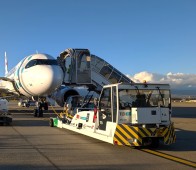



Reliability is built on the ground, not in the air
By Rene Pascua, CEO Latin America & Caribbean, Swissport
Latin America’s aviation sector is experiencing its most significant transformation in a generation. In 2025, the region handled more than 300 million passengers, with volumes projected to double by 2035. This growth is occurring alongside rising expectations for decarbonization, digitalization, and consistently high operational performance across some of the most diverse aviation environments in the world.
Having worked across the region for many years, I believe one of the most important shifts shaping aviation today is where reliability is actually created. From Mexico City to the Ushuaia, the assumption that airline reliability is primarily defined in the air is increasingly being challenged. In reality, operational reliability is increasingly determined on the ground.
Across Swissport Latin America & Caribbean’s operations in 14 countries, 85 airports, and 73 million passengers handled annually; we see this shift every day. It is reshaping how airlines design networks, assess operational risk, and evaluate long-term growth opportunities. Increasingly, consistent ground operations are becoming a direct contributor to airline profitability, resilience, and customer confidence.
Safety: From compliance to operational trust
Safety is no longer just a regulatory requirement in Latin America & Caribbean — it is becoming a core element of operational trust.
Across our region, we have embedded a “Just Culture” approach where safety leadership is distributed across frontline teams rather than centralized in management. In 2025, all Swissport locations participated in our global Safety Month, reinforcing this model in daily operations. The impact is measurable: a 46% reduction in aircraft damage rates and a 16% reduction in lost-time injuries across our regional operations.
For airlines, the implication is significant. Safety performance is no longer a backward-looking compliance metric. It is increasingly a forward-looking indicator of operational reliability, network stability, and disruption risk.
Operational excellence: Precision at scale
Latin America & Caribbean presents one of the most operationally diverse environments in global aviation, spanning high-density hubs such as São Paulo, seasonal operations like Puerto Williams, and remote island operations in Bonaire. Despite this complexity, Swissport achieved 99.4% on-time performance across all the Latin America & Caribbean region in 2025.
This level of consistency is not achieved through local adaptation alone, but through system design: standardized processes, unified rostering across multiple countries, and digital platforms such as IBM Maximo that enable real-time operational visibility.
The lesson for airlines is clear: operational excellence does not scale through expansion alone. It scales through systems capable of replicating performance consistently across markets while minimizing operational friction and delay-related cost.
Customer centricity: from supplier to operational partner
The role of ground handling in Latin America is shifting from transactional service delivery to strategic partnership. Airlines are increasingly evaluating partners not only on cost efficiency, but on their ability to enable network growth and operational flexibility.
Our expansion into complex environments such as the Galápagos Islands reflects this shift. These are not high-volume stations, but strategically important routes that require specialized expertise and unlock network connectivity that would otherwise not be viable.
Similarly, our growth with LATAM Airlines in Brazil and Ecuador reflects a partnership model built around operational adaptation to airline-specific needs, particularly around turnaround performance and reliability requirements.
In this context, ground handling is no longer a cost line. It is increasingly a strategic enabler of network scalability and customer experience.
Sustainability: Efficiency through decarbonization
Sustainability in Latin American aviation is often framed as a constraint. Increasingly, however, it is becoming an operational advantage.
The deployment of electric ground support equipment across Ecuador, Mexico, Costa Rica, and Aruba has demonstrated that decarbonization can improve operational performance through reduced maintenance downtime, higher equipment reliability, and improved utilization. This contributed to Swissport retaining EcoVadis Platinum status in 2025, placing us among the top 1% of companies globally for ESG performance.
For airlines, this changes the equation. Emissions reduction and operational efficiency are no longer competing objectives. They are increasingly aligned outcomes that reinforce both sustainability commitments and operational reliability.
Innovation: The infrastructure of reliability
Digital transformation has become a foundation for operational stability in Latin America. Our Matchbox platform in Mexico City and Santiago has reduced processing time per passenger while ensuring full compliance in inadmissible passenger handling. In a region with complex and evolving regulatory requirements, this is not only an efficiency gain. It is also a critical risk mitigation tool.
Combined with workforce management systems such as Dayforce and integrated rostering across six countries, this digital infrastructure enables predictable performance even under fluctuating demand conditions.
For airlines, innovation is no longer only about differentiation. It is becoming essential to operational resilience and scalable growth.
The shift airlines can no longer ignore
These five forces point to a broader industry shift: airline reliability is no longer primarily an airborne outcome. It is increasingly a ground-based capability built through safety systems, operational discipline, customer partnership, sustainable operations, and digital infrastructure.
Ground operations are no longer a support function in aviation. Increasingly, they determine whether airline networks scale efficiently or face operational friction that limits growth.
Latin America’s aviation growth is not in question. The region is entering a decade of unprecedented expansion. The real question is whether operational models are evolving fast enough to support it.
Airlines that recognize this shift early, and invest accordingly in operational reliability on the ground, will be best positioned to scale successfully across the region in the decade ahead.

Contacts
- Group Communications
- [email protected]